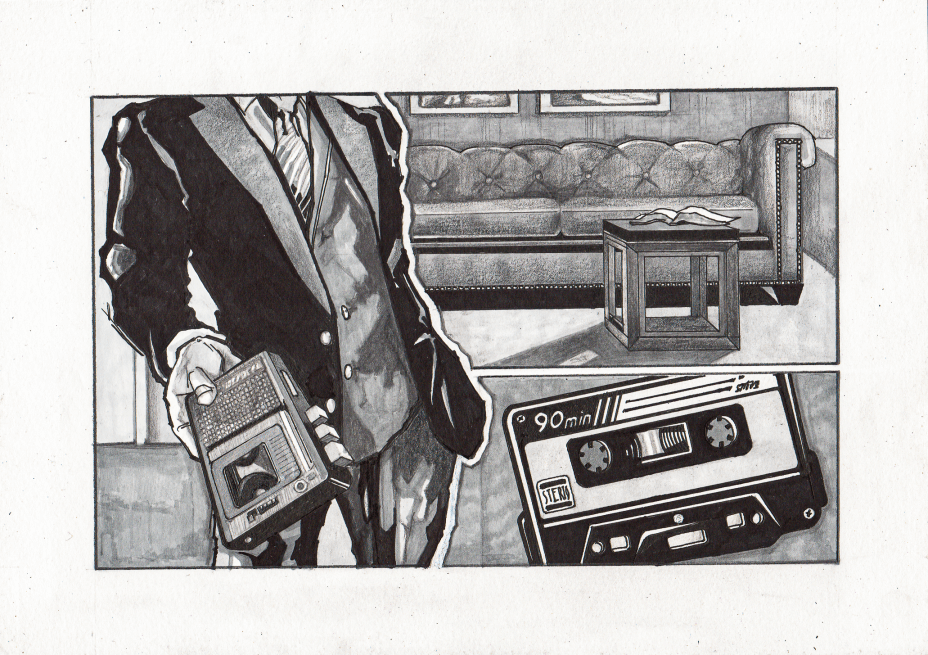
«They said I could choose: either rape, murder of civilians, or something else.» Azov fighter Danylchuk on his fabricated case in Russia

Dmytro Danylychuk, former prisoner of war and one of the defenders of Mariupol, on March 31, 2026. Photo: Sofia Soliar for Graty
On July 4, 2025, Dmytro Danylchuk, the Mariupol defender with the «Azov» brigade of the National Guard of Ukraine, returned from Russian captivity. He was brought for the exchange from Siberia. He ended up there after the Southern District Military Court in Rostov-on-Don had sentenced him for his alleged membership in a terrorist organization and involvement in terrorism-related drills. In fact, Russia, which designated «Azov» as an extremist and terrorist organization, basically sentenced Danylchuk for his service in the Ukrainian army, thus violating international humanitarian law, which prohibits parties to armed conflicts from prosecuting enemy combatants unless they have committed war crimes. Dmytro was tried by judge Konstantin Prostov, who, in May and September 2025, was notified of suspicion in absentia in Ukraine for violating the laws and customs of war, specifically the Geneva Convention provisions regarding the treatment of war prisoners. The Shevchenkivskyi District Court of Kyiv currently examines the case against Prostov with Dmytro Danylchuk named as one of the victims.
After several months in a prison camp north of the Arctic Circle, Danylchuk was brought to a meeting with an FSB officer. The man recalls that the officer first spoke of a possible POW exchange, then attempted to force him to take the blame in another case and to fabricate its circumstances.
Graty spoke with Dmytro Danylchuk about Azovstal and Olenivka, ‘pressure cells’ in Russian detention facilities, and other methods of coercion used against POWs, as well as the fabricated ‘terrorism’ case. His story follows.
Battle of Mariupol and the Capture
I joined the army in early 2018. I went to join «Azov» right away and remained with them. I was initially engaged in combat operations during the Joint Forces Operation (JFO). I was wounded by a sniper bullet at the Svitlodarsk Bulge . After rehabilitation, I was back on service. In 2022, I was already deployed to Mariupol.

Dmytro Danylchuk, March 31, 2026. Photo: Sofia Soliar for Graty
I ended up at Azovstal on April 15, 2022. Our commanders gathered us from our positions at night and told us that we were all being moved to Azovstal as we had been cut off from our own forces: some were at Azovstal, while we were in the city center. Then we set out in a convoy, which came under artillery fire; most of our vehicles were destroyed, and there were many dead and wounded. We made it to Azovstal, and once everyone had gathered there, we figured out where everyone was. So, we started our defensive operations right away.
My last battle with the enemy was on April 25. After that, there were no more infantry engagements; instead, we were bombarded by artillery, as well as by aircraft and naval artillery. We went out several times to help our comrades, but we failed, so we returned.
Then, due to ongoing negotiations, rumors started to spread that we would be ordered to surrender. And after May 10, I was [officially] informed of this.
On May 20, I was taken prisoner of war following orders from our command. We went out in groups in accordance with the lists prepared beforehand. At first, the «DPR» militants stood there with the Russians — they recorded our names in a logbook, and our people also recorded the ones who had left. So, we went out, and they searched us. There were also some PMC Wagner representatives, as well as some from our counterintelligence. Then we got on the buses, and they drove us away.
Our guards were the Dagestanis. First, they went through everything we had, took the better items for themselves, and left the bad ones behind. When we arrived, they gave us cigarettes, water, etc.
«In Olenivka, some people were treated harshly.»
On May 21, we were taken to Olenivka . By evening, I had already moved into the barracks.
In Olenivka, some people were treated harshly [by the Russians]; they were taken straight to the disciplinary isolation unit (DISO) where they were beaten, tortured, and subjected to other types of abuse. They interrogated me two or three times: the Investigative Committee came and questioned me about what had happened in Mariupol. There was no strict regime there; we were allowed to sleep. The food was bad, there was no drinking water, and no toilet.
At one point, they — as it seemed to me — randomly selected up to 200 men and moved them to another barracks. They stayed there for a day and a half, I think, and then the place was hit.
Those barracks were right nearby. When that strike was coming, the Russians fired two Grad barrages right by our windows, exactly in our area; we could see everything. They fired two Grad barrages in our direction . I guess, they wanted to make it [look] as though our side had retaliated, hitting the barracks, and people were burned there. They provided no aid after the impact — nothing. [The wounded] were bleeding to death, while those guys were walking around, drinking coffee right next to them, filming them, and laughing.
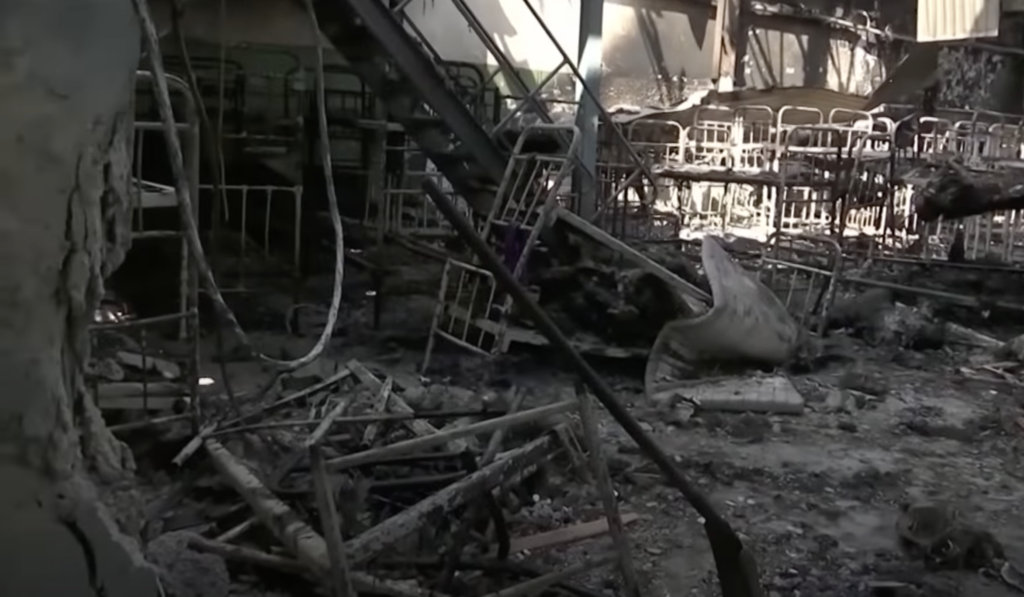
The aftermath of the explosion at Volnovakha Penal Colony No. 120 (Olenivka) on July 29, 2022. Screenshot from a video by Reuters
Those with minor injuries were sent to DISO; they were in the same colony. There were about 30 of them, and the cell was no bigger than two by two meters, with one toilet only; they didn’t have any water either, nothing. They stayed there until they were transferred: some of them to Donetsk, and others, like me, to Taganrog.
«They beat us twice a day; some of us more often, depending on their capacity.»
I spent about three months in Olenivka, and on September 26, they moved us by truck to Taganrog. First, they blindfolded and tied our hands, threw us into the cargo area of the truck, and brought us to the detention center. There, we went through what they called ‘reception’: they beat us for around six hours, and then finally took us to our cells. I spent 19 months in that cell. There were seven of us there.
Everybody had their own bed. At first, they didn’t take us to the bath or anywhere else; they didn’t give us razors to shave, and they didn’t cut our hair. We sat there like that for about two months. They beat us twice a day; some of us more often, depending on their capacity. Later, they gave us soap and took us to the bath. The food was so bad that… I don’t know, even a dog wouldn’t eat it under normal circumstances, but that’s what they gave us. There was a toilet, and there was water. Later, they started handing out toilet paper, toothbrushes, and towels.
Then they transferred me to Rostov-on-Don. At first, into some premises where the FSB investigators were present. They took off my blindfold, said I’d go on trial and drew up some protocol. An attorney came and started questioning me, just like the investigator before him.
After that, they transferred me to a pre-trial detention facility. They brought us to the court, which imposed the so-called measure of restriction for two months, I think, and detained us in Rostov’s Pretrial Detention Center No. 1 (SIZO-1). I entered the cell; there were about 30 people there. They were POWs from «Azov», «Aidar», and «Donbas» units; there were also several external Security Service (SBU) operatives, as well as civilians detained in 2016–2017, mostly in [occupied] Donetsk. The cell was located in the basement. There was basically nowhere to sleep, because there were only about eleven bunk beds for all of us.

Dmytro Danylchuk, March 31, 2026. Photo: Sofia Soliar for Graty
The overall conditions there were better [than I had experienced before], as I could make coffee or tea, if available. And the food was better. Those who had relatives in the occupied territories — such as Donetsk or Melitopol — could receive packages. Their loved ones could visit them and come to the court sessions. There was more communication, and we could receive some news.
[During all that time] they often transferred me with Russian soldiers who had been imprisoned because they had either killed their own men or done something else. They didn’t express negative attitudes towards me; they said: You’re fighting for your country, and we’re fighting for ours. One guy got sentenced to 18 years for a double murder; he said: I’d rather serve 18 years in prison than go to war.
Three Sessions of Closed Proceedings and Denial of Appeal
In Rostov, I was sentenced to 18 years after three court sessions. The trial was closed: the judge, the prosecutor, the court clerk, the attorney, and some guard — no one else was there, and there was no TV coverage.
They asked, «Were you in the Azov?» — «Yes.» They consider «Azov» a terrorist organization. My comrades testified, confirming that I’d been part of the «Azov» unit. They asked: «Were you trained?» — «I was.» Well, that’s it, now you’re a terrorist. That was the whole process.
The first attorney they provided never came to the first session; another woman came instead, but she didn’t do anything: she just sat there and listened. She didn’t even talk to me. Then they replaced her, too, and appointed another attorney who told me something like: Don’t talk smack, and everything will be fine, they’ll exchange you. By «talking smack,» he meant saying that Russia is bad, etc. For that session, I was on a video call from my detention center. And only at the next session did I meet that attorney in person in the courtroom.
I wanted to appeal so I could stay in the SIZO longer. I was hoping that this way I’d be closer to the border, and at some point they’d be able to exchange me. I filed an appeal, but it probably never left the SIZO. They ordinarily don’t let appeals out of the detention centers, which basically means you’re convicted, so they send you further away.
Transfer to Norilsk, North of the Arctic Circle
So that was it, they sent me to Taganrog again for two months. The conditions were better this time: there were fewer restrictions, and they beat us less, too. The administration pressured us psychologically and put us in stress positions.

Visit by prosecutors, public observers, and the Children’s Rights Ombudsman to Taganrog Pretrial Detention Center No. 2, February 2022. Photo: Federal Penitentiary Service Directorate for the Rostov Region of the Russian Federation
Then I was transferred to Rostov, to Pretrial Detention Center No. 5 (SIZO-5). After Rostov came Voronezh, Samara, Orenburg, Chelyabinsk, and Krasnoyarsk. In Krasnoyarsk, I spent about two weeks in the pretrial detention center attached to the prison, sharing a cell with their convicts [under criminal law] — or rather, one week with them and one week in solitary confinement.
They brought two of us there: me and one «Aidar» fighter. An officer from the Federal Penitentiary Service (FSIN) spoke with us and told us to sign a document stating that I agreed to tell [the administration] everything that was happening. I refused, so they threw me into a cell with Russian inmates so they could ‘pressure’ me a bit.
Finally, they put me on a plane to the prison camp in Norilsk, which is located north of the Arctic Circle in Krasnoyarsk Krai. I spent around three months there with Russian inmates. Based on my sentence, I was placed under a «strict regime,» the « strict detention conditions » in a high security prison camp. It’s like prison: you sit in a cell and cannot go anywhere. But things were much better for me there. There was a TV, so I watched some of their news programs. There was a kettle, so I could make some tea.
At the time, I was the first POW who ended up there. There was another [Ukrainian] from Odesa, but he was sentenced for terrorism back in 2021; they accused him of having ties to the « Right Sector .» He was sentenced to nine years, and he’s still in there.
Maybe it was once or twice that [the Russian prisoners in Norilsk] expressed a negative attitude towards me, but they mostly kept to themselves; I rarely crossed paths with them. Others asked questions, wanting to know what was going on; they didn’t want to go to war.
They also forced me to shovel snow. I shoveled snow for about two weeks. It’s almost always winter there; I’ve experienced temperatures as low as minus forty [Celsius], and even in the early summer months, there’s still snow lying around here and there. The building had hot water and heating, but it was still cold. At least they gave us all the warm clothing they were supposed to. The administration was kind of captious. I didn’t understand: did they want something from me, or did they just want to find out what was happening in this war?
«They said: ‘Make up your story; if we don’t like it, things will get worse for you.’»
Then an FSB agent arrived and said they would send me back to Krasnoyarsk, where I would take a ‘lie detector’ test. They said, «If you pass and tell the truth, we’ll exchange you.»
So I arrived in Krasnoyarsk. I took one ‘lie detector’ test; they asked if I would go back to fight. They claimed the detector showed that I would, and that was the bad answer. They also said that I was covering for someone because I hadn’t told them who did what.

Dmytro Danylchuk, March 31, 2026. Photo: Sofia Soliar for Graty
And they wanted me to take the blame for the murder of civilians. They said that if I confessed, they’d give me an extra two years, but if I didn’t, I’d get a life in prison.
The FSB investigator’s name was Colonel Menshikov — I don’t remember his first name. He started building up this case. It went on for about three months. They turned the inmates against me. There’s this notion of a “pressure cell.” They put me in such a “pressure cell” with those inmates. For the first two weeks or so, they beat me there, forced me to clean the cell, then they eased up on the physical pressure and focused more on the psychological. The operatives and investigators told me they would take me somewhere to get raped. They threatened me with sexual violence.
There was video surveillance everywhere, but also they later moved me to a cell where audio recording was set up. The inmates asked me questions, and I had to respond.
I was expected to take the blame for two murders of civilians in Mariupol. They told me I could choose among three options: either rape of civilians, murder of civilians, or something else. They said, “Make up your story; if we don’t like it, things will get worse for you.” They liked one story but not the other one, so they told me to change the latter. I changed it, but by the time I had to present it to them, the exchange process had started.
They also forced me to record a video, where I asked ‘Russian soldiers’ and ‘Russian mothers’ for forgiveness. A TV crew — I think it was from «Rossiya-1» — came and filmed me. They gave me a fictional script according to which I was supposed to say that Ukrainians have « barrier troops ,» that I was one of such troops, that the Territorial Defense soldiers were ahead of me, and if any of them abandoned their position, I was supposed to shoot them based on our commander’s order. They pointed to a piece of paper: «Say this on camera.»
«Sign the pardon notice, but don’t indicate the date.»
And then, they suddenly showed up in the morning and said, «Danylchuk, sign this.» I asked what it was. It said: «Entry into the Russian Federation’s territory prohibited for 10 years.» Then, two hours later, they come back and say, «Sign the pardon notice, but don’t indicate the date.» I thought it meant they wouldn’t exchange me anytime soon if I wasn’t supposed to write down the date. Besides, how long would it take to get there: a month or a month and a half to the nearest border?
But just a few hours later, they told me to «grab my stuff and leave,» and they led me out. I saw other POWs who had been brought from prisons to this SIZO, and I saw some people I knew. They closed our cases in our presence, we signed the paperwork, and we were transported to the airport, where we were handed over to the military police and put on a civilian plane; this time, they didn’t tie our hands or blindfold us.
We landed in Novosibirsk, I think, and there they tied us up and started bringing new people onto the plane. I don’t remember how many times — maybe three or four — we landed and took off; the whole thing lasted about a day and a half. Then they took us into some kind of hangar; we sat there for three or four hours, tied up, and they did a roll call by last name. Another plane landed with the POWs. They gathered us all onto one plane and transported us to Gomel, Belarus. There, they took off our blindfolds, we got on the buses, and they drove us to the Ukrainian border.

Ukrainian prisoners of war released during a prisoner exchange, July 4, 2025. Photo: Security Service of Ukraine
I’m still undergoing rehabilitation. After that, I’ll get three months of leave, which is granted to all former prisoners of war. Then you decide whether you want to continue service or leave.
I decided to continue.
Translation by Yustyna Kravchuk, edited by Anna Kravets and Anastasia Moskvychova.
This publication was supported by the International Renaissance Foundation. The article reflects the point of view of its authors and does not necessarily represent the views of the International Renaissance Foundation.
Нашли ошибку в тексте?
Выделите ее и нажмите Ctrl + Enter
Выделите ее и нажмите Ctrl + Enter