Ukrainian children’s future left to Italian courts
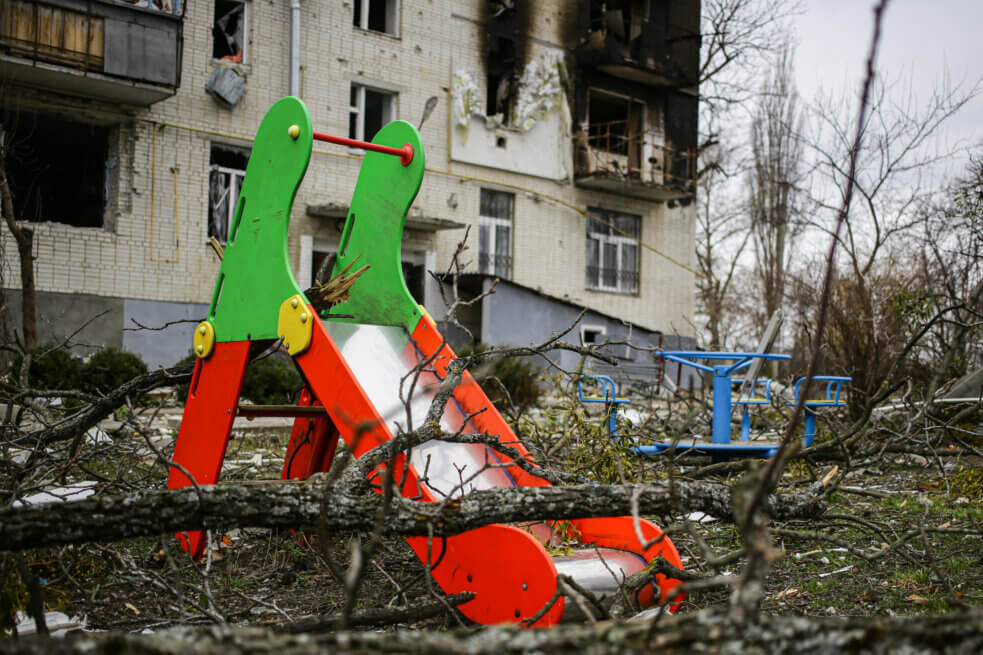
A playground against the backdrop of a high-rise building in Trostyanets that was shelled by Russian forces, April 2022. Photo: Stas Yurchenko, Graty
Text by Nataliya Kudryk
Italy has taken in several hundred Ukrainian children from care homes since 2022. Many Italian families are willing to host and care for them. As these minors are now under Italian jurisdiction and the security situation in Ukraine has not improved, an urgent priority for the Ukrainian authorities is to re-establish partial oversight of their living conditions, with a view to their eventual return home.
In the first weeks of Russia’s full-scale invasion, 4,739 orphans and children deprived of parental care were temporarily evacuated to European countries with the Ukrainian government’s permission. Kyiv gradually began to repatriate these young people, but according to the State Service of Ukraine for Children’s Affairs, as of April 2025, over 1,700 children (around 40 percent) remained abroad. Some countries, citing local court rulings, do not allow minors to be taken out of the country due to the protracted state of war in Ukraine.
This list includes Italy, which has taken in several hundred Ukrainian children from care homes since 2022. Currently, over 100 children are in the country’s southern regions, mainly in Calabria and on the island of Sicily, as well as in the northern Lombardy region in the province of Bergamo. As Italy has taken these minors under its jurisdiction and the security situation in Ukraine is not improving, the urgent task for the Ukrainian side has become not so much the swift return of the minors as the restoration of partial supervision over the conditions of their stay in a foreign country with a view to their future return to their home country. The Ukrainian Consul General in Naples says that due to opposition from local guardians, the situation has reached a legal impasse and a protracted legal battle lies ahead.
Out of place
Mykola Lokotosh, an 18-year-old native of Uzhhorod, arrived in the southern region of Calabria in the spring of 2022 with a group of pupils from the Chynadiyevo boarding school (Zakarpattia Oblast). In a telephone conversation, the young man explained that although their facility is located in a safe region, the management decided at that time to temporarily evacuate abroad the children who had international travel documents. This was done to make room for other children from care homes arriving from the frontline zone, in particular from the Sumy children’s home. This version of events was also shared with the facility’s former director, Svitlana Sofilkanich, as well as Yulia Dynnychenko, a representative of the Ukrainian New Horizons Association in Sicily. This was also true of one of Dynnychenko’s colleagues (speaking on condition of anonymity) from another Ukrainian association in southern Italy, who helped organize the reception of the minors.
As Lokotosh recalls, after his first few days in the hostel, he was placed with an Italian foster family in the town of Vibo Valentia, where the then 14-year-old felt completely out of place. “I always had to stay in my room; there were constant restrictions. I was only allowed out to go to school, and when I came back from lessons, I couldn’t go out for a walk with my mates. I asked to be moved to a different family, but that didn’t happen. So I decided to do something to get myself taken away from that family. And I beat up their ten-year-old son, because he often insulted me, and I couldn’t stand it,” says Mykola, going into detail about his deliberate misbehaviour. The boy was eventually taken away from that family and, with the help of local social services, placed in a children’s home 70 kilometres away in the city of Catanzaro, where he still lives today.
“I’m fine here. I’ve been used to children’s homes since I was little. My parents died when I was very young. In Ukraine, one foster family treated me badly, so I’d rather be in a children’s home than with some family,” Mykola continues. He has three sisters. The youngest, who came to Italy with him, lives in Vibo Valentia with an Italian foster family. She is doing well in her new family and, according to Mykola, wants to stay there.
When we start talking about his hometown, the young man speaks wistfully of his grandparents and other relatives in Zakarpattia, whom he misses, but he has no intention of returning home at present. Having reached adulthood, Mykola can decide for himself where to live, and he is no longer listed among the minors whom the Consulate General of Ukraine in Naples is seeking access to, having become bogged down in legal wrangling. As the diplomatic mission informed, many of the children, having reached the age of 16, previously returned to their home country with the assistance of the Consulate General. It is clear that diplomats can also assist children who have come of age in the meantime with the paperwork required to travel to Ukraine. However, these young people have not been in contact recently, the Consulate General in Naples added. This is a fact confirmed by the story of the young man from Uzhhorod.
Change of status
As of February 2026, around 20 teenagers from Chynadiyevo remain in Calabria and six on the southern island of Sicily. On the same island, more than 50 children from the Emerald City social rehabilitation and health centre in the Donetsk region are currently staying with foster families or in relevant facilities.
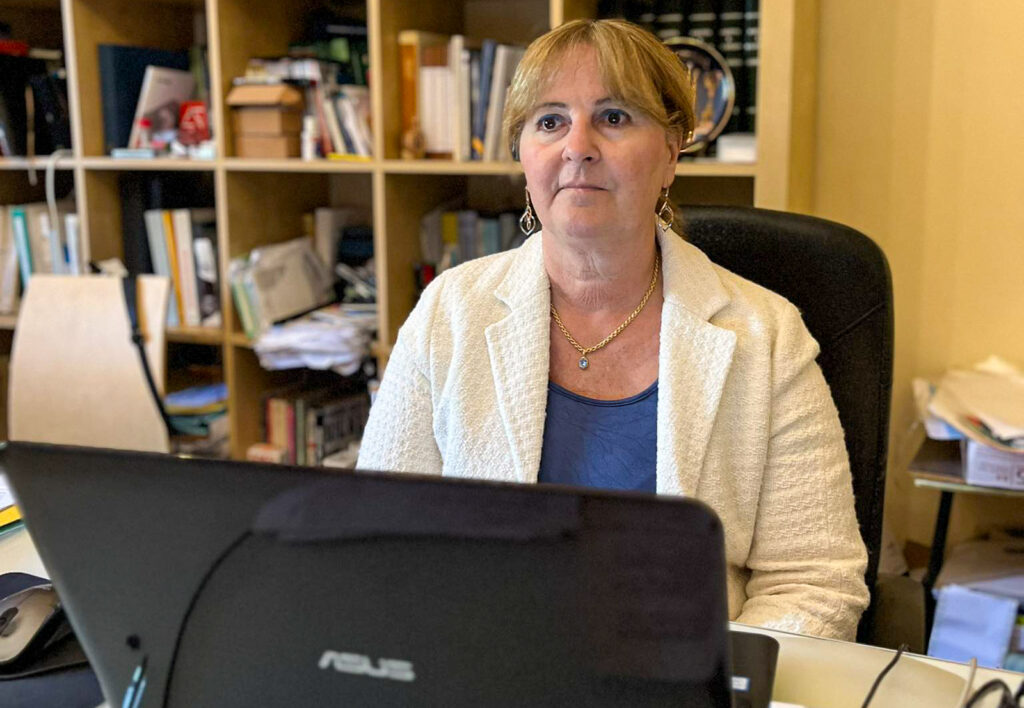
International lawyer Rosa Emanuela Lo Faro. Photo from her law firm’s Facebook page
In the first few months, in accordance with local legislation on the protection of foreign minors, these Ukrainian arrivals were granted residence permits in the country as minors. However, as of today, almost all these children have been granted a different legal status—international protection, specifically refugee status—by decision of the territorial commissions, which has radically changed the situation. This was confirmed by the international lawyer Rosa Emanuela Lo Faro, who has handled dozens of court cases involving Ukrainian children in Sicily.
“The new status means that the Ukrainian state has lost custody of its underage citizens; the children can no longer have contact with diplomats from their country of origin; that Ukraine has effectively been removed from the process; and the host country [Italy] is free to decide even on the adoption of these children without Ukraine’s knowledge. Under international law, Italian citizens may adopt children who have been recognized as political refugees,” Lo Faro explains.
Under the international protection procedure, the host country is not obliged to provide information about asylum seekers to their country of origin. Applications for international protection for Ukrainian minors began to be submitted in 2024 by their temporary Italian guardians—lawyers appointed by local juvenile courts. These guardians, according to Lo Faro, under pressure from Italian foster families and influenced by negative news from Ukraine, have thus found a loophole in the legislation to prevent the return of young orphans to their home country. According to her, foster families are genuinely convinced that these children will have a better life in Italy, as they are allegedly treated poorly in Ukrainian residential care homes, a fact some of the minors have testified to in court hearings.
Lo Faro stated that responsibility for the change in status of the evacuated orphans lies with the Italian state itself, specifically the interior ministry. This department, she says, allowed regional commissions to grant protection to Ukrainian children under the legal procedure for the international protection as refugees. The commissions grant this status to the children even though Italian courts had previously ruled in favour of the Ukrainian guardians and granted them permission to return the Ukrainian orphans to safe places in their homeland.
“We are not allowed to communicate with the children because the temporary Italian guardians have filed applications for international protection status for the children, stating that communication with representatives of Ukraine could pose a threat. We are now forced to resolve these matters exclusively through the courts, where we are no longer talking about rights, but about a struggle,” said Maxim Kovalenko, Ukraine’s Consul General in Naples.
According to him, juvenile courts in the Sicilian cities of Catania and Palermo have assured diplomats that, whilst martial law is in force in Ukraine, the adoption of these children in Italy is not possible. However, once the conflict ends, “this issue may be resolved differently.”
Unaccompanied minors
Following the change in the children’s status, even their temporary Ukrainian guardians on the ground, registered with the Consulate General, are not permitted to communicate with them.
“I only had official status as the children’s representative guardian in Calabria for the first three months,” says a former guardian on condition of anonymity. “I helped to process their documents and assist with local social services. We sought foster families whose suitability was verified by the court. I asked for the children to remain in my care, but the Juvenile Court of Catanzaro decided otherwise. Italian guardians were appointed for them, and after that I could not have any contact with the children.”
The woman has long since emigrated to Italy and is a member of a Ukrainian association which helped to take in a group from an orphanage.
In general, the courts in Sicily and Calabria frequently prohibited contact between the children and their legal Ukrainian guardians from the very first weeks of their stay, initially granting the children the status of “unaccompanied minors”. However, in accordance with international and Ukrainian legislation, the refugee children were accompanied by persons legally authorized by Ukraine. As Lo Faro, the legal expert, explained, local judges, ignoring international agreements like the 1996 Hague Convention, decided that the documents of the Ukrainian guardians could not be applied on Italian territory.
“These are orphans or children deprived of parental care who were in institutions in Ukraine,” La Faro said. “These are children who belonged to Ukraine. They did not flee the country, unlike the truly unaccompanied minors who arrive here from Morocco or Egypt, because these African children often have parents. This is an important distinction. And we should be talking about misconduct on the part of the Italian temporary guardians.”
Some courts take national law into account over international conventions. In these cases, Italy has effectively brought these children under its jurisdiction, removing Ukraine—their country of origin—from custody. Diplomats are also convinced that such actions by the judicial authorities contravene the 1996 Hague Convention on Parental Responsibility.
Back in 2023, following a submission by Yulia Dinnichenko, a Ukrainian temporary guardian from Sicily, even the Italian Court of Cassation confirmed her status within the country. Later, in 2024, the Supreme Court established the exclusive authority of the Consul General of Ukraine to appoint such guardians and, where necessary, lawyers for minors from among trusted individuals, which the Italian authorities must recognize in accordance with the Vienna Convention on Consular Relations. However, in the aforementioned cases in Sicily and Calabria, it is clear that not all judges adhere to international law or heed the decisions of their Supreme Court, giving preference in such cases to national laws on the protection of minors. Despite requests for comment to the president of the Juvenile Court in the Sicilian city of Catania, where, as of April 2022, there were already 110 young Ukrainians with “unaccompanied minors” status, no response was received.
In whose best interest
In January this year, in the town of Tropea in the Calabria region, during a conference on the protection of minor rights, the issue of young Ukrainian war refugees who are still in the region was also raised. The lawyer Raffaele Figliano, who acted as a legal representative for a Ukrainian teenager in court, took part in the public discussion. The lawyer explained the situation from the perspective of the local judiciary regarding the case of Ukrainian orphaned minors.
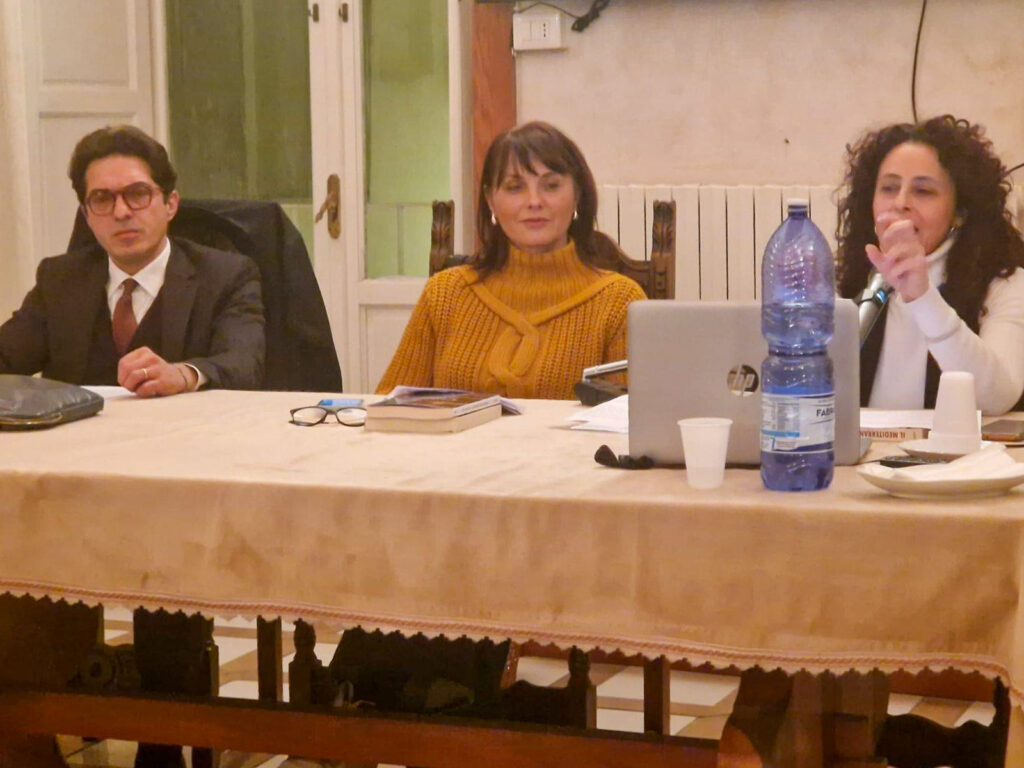
Raffaele Figliano (left), a lawyer specializing in family law and the protection of minors, at a conference in Tropea, 2026. Photo: Natalia Kudryk, Graty
“Yes, the Court of Cassation is doing what it is supposed to do: acting in accordance with regulations and laws. At the same time, we must understand the real emergency situation we face with the mass arrival of young refugees fleeing the war. We are concerned first and foremost with the best interests of the child. And if you [the guardian] arrive from Ukraine, go to the police with 50 children and say that you are their legal representative from their country of origin … where are we supposed to place them all? Who will be responsible for each of them? We are talking about people! I agree with the decision of the Court of Cassation, but it is not being followed either in Sicily or in Calabria,” said Filiano, a specialist in family law and the protection of minors.
The lawyer is sceptical of the Ukrainian consulate’s arguments regarding the children’s return home and explains:
“If the active phase of the war is ongoing, with certain regions of your country being bombed daily … does allowing these children to return to Ukraine contravene international law or not? The answer is often yes.”
In this lawyer’s view, the relevant ministries are truly responsible in such cases, as they are tasked with regulating such emergency situations at the intergovernmental level. The main argument against returning the children is the lack of safety.
Ukrainian diplomats have held several meetings in Rome at the ministries of justice and foreign affairs, where officials express understanding of the circumstances and send recommendations and clarifications regarding the application of international norms to the regions. At the same time, Italian government officials emphasize that the judicial system is an independent branch of government and they have no right to interfere or exert pressure on judges. The courts, for their part, state that they take the government’s recommendations into account but are not obliged to follow them. In short, a deadlock has arisen, according to Kovalenko.
According to the consul and representatives of local Ukrainian associations, Italian families are often keen to keep the children with them and look after them as well. However, many of the children lose touch with their homeland. They forget Ukrainian, as social services or foster families do not concern themselves with preserving the national identity of these refugees. The Italian authorities allocate between 100 and 500 euros per month to support each child, depending on the needs of the individual family or the children’s home. If they did not like living with the families, some children returned to Ukraine on their own, with the permission of local juvenile courts.
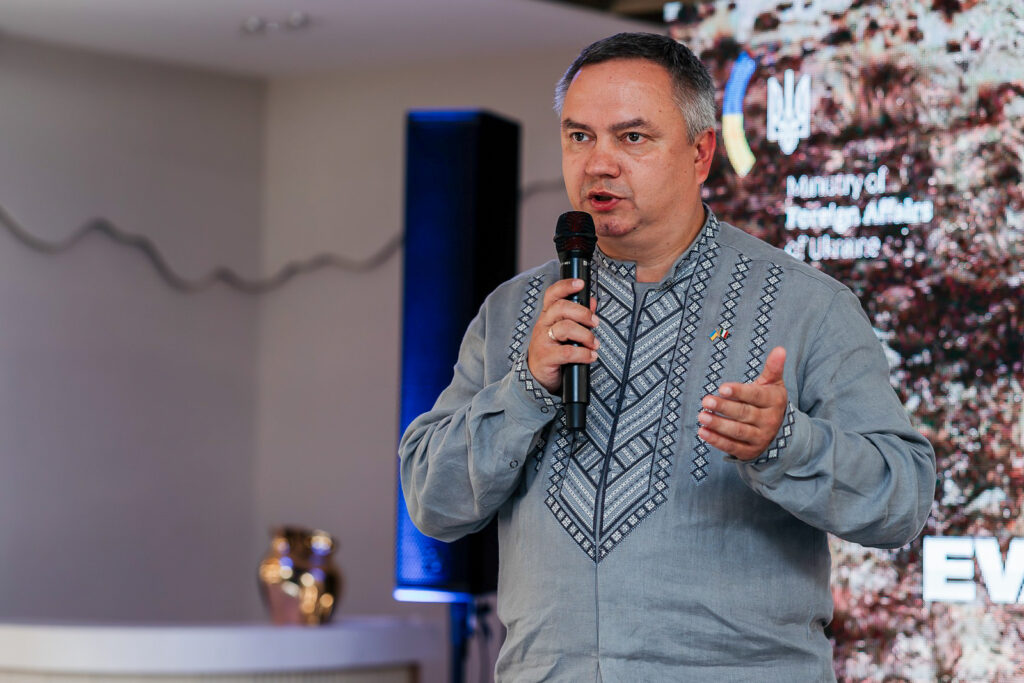
Maksym Kovalenko, Consul General of Ukraine in Naples. Photo from the consulate’s Facebook page
“While we were with the children, we organized Ukrainian games, spoke in our native language, and gathered for dinner with the families. But later, once we were removed, neither the families nor the social care homes gave any thought to their Ukrainian upbringing,” said a former Ukrainian carer, delegated by the consulate, who looked after young arrivals in Calabria.
The young man Mykola Lokotosh, now living in a different city from his sister, keeps in touch with her and says they already speak Italian, as the girl is forgetting her native language, having arrived in Italy at the age of ten. Mykola himself tries to speak Ukrainian, but in reality it is a Ukrainian-Italian mix. The boy cannot recall the Italian carers offering him any lessons in his native language. At the same time, according to the consul, the judges assure him that in some of the orphanages, an educational programme in Ukrainian is indeed provided for the children.
Difficult decision
The children’s prolonged stay in an Italian environment and their personal statements in court expressing their unwillingness to return to their homeland are compelling arguments for the judge to deny Ukraine’s request for the return of the minors. Therefore, even if the armed conflict were to end, lawyers and diplomats predict that it would be impossible to return these children, as it would be argued that this is contrary to the child’s best interests. For now, however, the Ukrainian authorities are more concerned with at least gaining access to the children to check on their living conditions, which, according to the judges’ reports, are considered acceptable.
“The children here do not want to return to Ukraine. The boys live in shelters, they are afraid of ending up in the war, and there are a few girls with families. One child was very withdrawn at first, but has now opened up and is feeling better. Overall, they are doing quite well here,” said a former Ukrainian carer.
When the topic of visiting Ukraine came up, Mykola from the Chynadiyevo facility replied categorically:
“No, I don’t want to go to Ukraine, because I might have to join the army. There’s a war there, even though it’s far from my home. My relatives are trying to talk me out of going back. Once I leave this children’s home, I’ll earn some money here and go to my other sister in Switzerland. I don’t like it in Italy. And if the war ends, I’ll return to my homeland.”
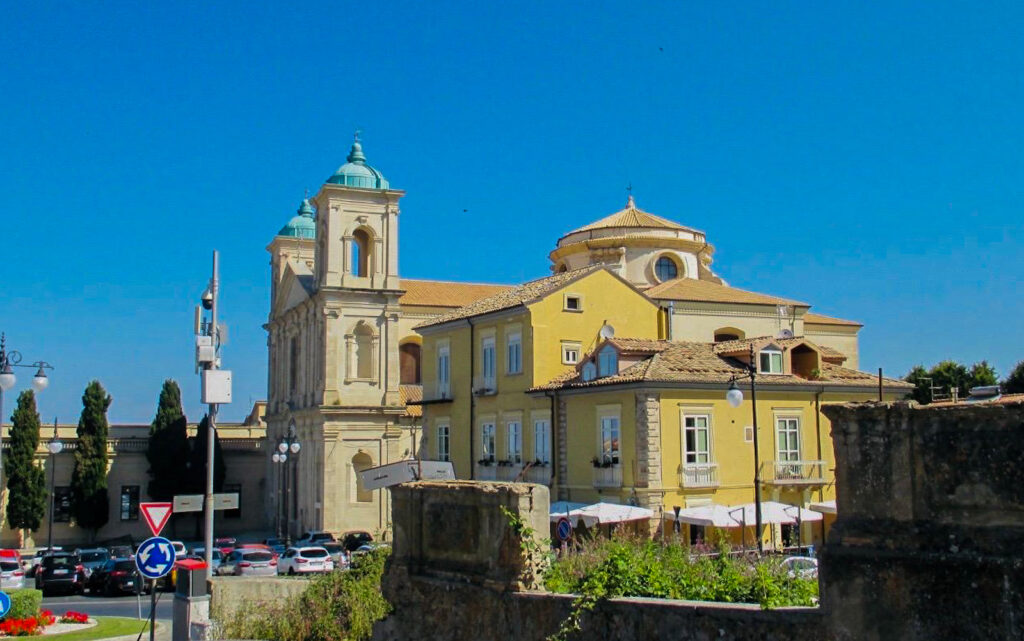
The city of Vibo Valentia, Calabria region, Italy. Photo: Natalia Kudryk
However, there are other situations where children wanted to return home to Ukraine. Some left quickly, whilst others are still waiting due to a lack of court decisions, or have been refused. At the start of the full-scale Russian aggression, a group of 25 children from the Stepan Suprun Children’s Home in Sumy arrived in southern Italy, according to the home’s director Lyubov Rudyka. Since 2023, she said, most of the children have returned to Ukraine with the permission of local courts and without hindrance from their host families, particularly to the Ternopil region, and have been placed mainly in family-based care. As of today, five minors from the institution remain in children’s homes in the regions of Apulia, Campania and Abruzzo. These children, according to Rudyka, have expressed a desire to return to Ukraine, but have been waiting for months for court permission to leave, with no explanation given for the delay.
Our investigation discovered that there are currently 29 children from the Berdiansk boarding school (from the Zaporizhzhia region in occupied territory) still in the northern Italian province of Bergamo. In 2022, the entire group (115 pupils) was evacuated to the Apennines. According to Andrii Kartysh, Ukraine’s Consul General in Milan, seven pupils from the aforementioned school returned to Ukraine last year. Four of them went on to study at vocational schools, whilst three found new Ukrainian families. With the assistance of diplomats, work is ongoing in the case of one child to place them with prospective Ukrainian foster parents and facilitate their subsequent return to their homeland. The remaining children have not yet expressed a desire to move home or meet prospective Ukrainian foster parents. Consular staff have been able to maintain contact with the children.
In the summer of 2024, a scandal erupted over the return of this group from Berdiansk, as the local juvenile court initially agreed to the Ukrainian authorities’ request for 57 orphaned children to be sent abroad. However, their departure was then suspended following applications for the minors to be granted international protection status.
This translation of the original Graty article was first published in the New Eastern Europe Magazine.
Знайшли помилку в тексті?
Виділіть її та натисніть Ctrl + Enter
Виділіть її та натисніть Ctrl + Enter