«The courts produce identical rulings.» Russia’s Supreme Court refuses to consider Crimean journalist Lutfiye Zudiyeva’s appeal against her “foreign agent” designation

Lutfiye Zudiyeva
Photo: Lutfiye Zudiyeva's personal archive
Photo: Lutfiye Zudiyeva's personal archive
The Supreme Court of Russia, the country’s highest court of appeal, decided, following a preliminary review, not to refer the Crimean human rights activist and Graty journalist Lutfiye Zudiyeva’s appeal against her designation as a «foreign agent» to a panel of judges. The decision was issued by Judge Vladimir Khamenkov on June 2, but the journalist and her lawyer were only recently able to review the relevant document.
Earlier, in an effort to challenge her «foreign agent» designation, Lutfiye Zudiyeva exhausted all three levels of judicial review in Russia. The proceedings were marked by numerous procedural violations. For example, her attorney was denied access to the cassation hearing, raising concerns about a violation of the journalist’s right to a fair trial.
Graty has been following the course of this case and reporting on major developments.
«I view this decision as political rather than solely legal»
Lutfiye Zudiyeva has been appealing her «foreign agent» designation for over a year. At the same time, Russian judges failed to establish that she had been paid by foreign sources, and focused exclusively on her allegedly being «under foreign influence,» treating her peaceful and lawful journalistic and human rights activities, as well as her interviews with media outlets and international organizations about the situation in Crimea, as constituting such influence.
Judge Vladimir Khamenkov of the Administrative Cases Chamber of the Supreme Court of Russia noted in his review (a copy of which is in Graty’s possession) that he could not assess the circumstances of this case independently, but had to rely on the conclusions of lower courts, and that the subject of his review was limited to determining whether any procedural violations had occurred that could call into question the previous rulings.
«Contrary to the claims made in the appeal, listing the administrative appellant, who is engaged in the aforementioned activities, as a foreign agent is not an interference with her right to freedom of expression and dissemination of information, but is aimed at informing citizens and officials about her being under foreign influence, spreading messages and materials that can potentially threaten the security and sovereignty of the Russian Federation, for an unlimited number of individuals,» the document reads.
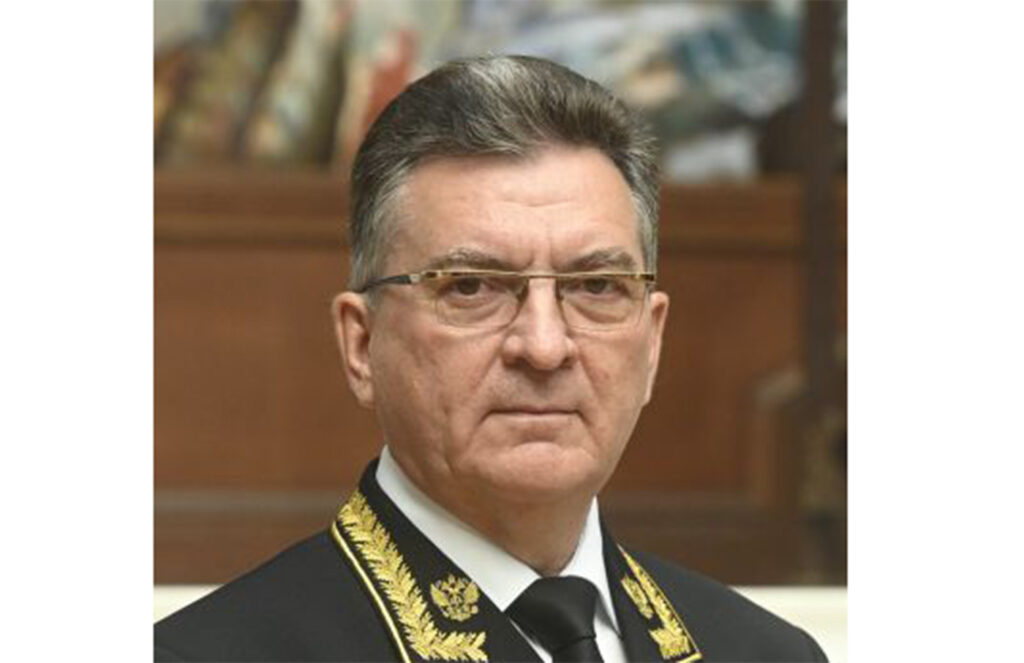
Judge Vladimir Khamenkov of the Supreme Court of Russia. Photo: ssrf.ru
Commenting on this decision, Lutfiye Zudiyeva said it was predictable, and from her observations, she could trace the same approach as in other cases involving «foreign agents.»
«That is why I view this decision as political rather than solely legal,» the journalist says.
Zudiyeva explained that her goal was not to challenge the circumstances the lower courts relied on, but to prove that such circumstances could not serve as the basis for legally designating someone as a «foreign agent.»
«In the appeal, we argued that the courts had misapplied the law by characterizing journalistic activity as political. Thus, they failed to apply the provisions of the [Russian] constitution and the International Covenant on Civil and Political Rights. Instead, they applied the Law on Monitoring the Activities of Individuals under Foreign Influence. Essentially, our issue was not with the facts, but with the incorrect application of the law. These are precisely the kinds of cases that the cassation court should review,» she added.
However, the court has not actually conducted any review. According to Zudiyeva, the judge only made a limited claim that the designation had a legitimate purpose, but did not address whether such a restriction of rights was truly necessary and proportionate, which is one of the key criteria when reviewing any restrictions on constitutional rights and freedoms.
«It seems as if the entire judicial practice regarding the appeals against ‘foreign agent’ designation follows a particular pattern. The courts issue almost identical rulings and typically do not attempt to critically assess or review the acts and conclusions of the Russian Justice Ministry, but simply take them for granted,» says the journalist.
«Foreign agent» designation as a way of pressuring independent journalism
Lutfiye Zudiyeva lives in Crimea and covers repressions on the peninsula, specifically by the Russian law enforcement against the Crimean Tatars and Muslims. She herself has been persecuted: she was detained while working at court hearings, her house was searched, she was fined and handed «warnings against illegal actions.»
On May 16, 2025, the Russian Ministry of Justice designated Lutfiye Zudiyeva as a «foreign agent,» deeming her journalistic and human rights activities «political.» The Ministry of Justice based its decision on the «information» that they received in 2024 and 2025 from Roskomnadzor and the Crimean branches of the Russian Ministry of Internal Affairs and the FSB.
Among other things, they mention articles by Lutfiye Zudiyeva published by Graty; interviews that she gave to international media and media organizations, such as Reporters Without Borders (RSF) and Committee To Protect Journalists (CPJ), regarding the situation of persecution and politically motivated criminal cases in Crimea, as well as her alleged membership in an international organization supporting human rights activists, the Front Line Defenders foundation.
The latter claim has nothing to do with reality: the foundation did, indeed, publish petitions acknowledging Zudiyeva’s activism and journalism in Crimea as peaceful and legitimate human rights work. Yet, she has never been listed as their staff employee.
The case also alleges that Zudiyeva had received funds from foreign sources based on her husband transferring money from his account to hers for household expenses. Her husband’s business activity in Crimea entails selling agricultural goods, and, as established by the FSB, he allegedly received funds from three foreigners between February and August 2024. They were citizens of Germany, Ukraine and Vietnam. No other indications of «foreign funding» are mentioned in the case of Lutfiye Zudiyeva.
Lutfiye Zudiyeva herself rejects the claim that she acted in the interests of any state and disagrees with the characterization of her journalistic activities as «political,» pointing to the fundamental right to freedom of thought and expression, guaranteed both by the International Covenant on Civil and Political Rights (Article 19) and the Russian Constitution (Article 29).

Russian police officers near the Kyiv District Court in Simferopol (illustrative photo). Credit: “Crimean Solidarity”
The journalist had initially filed a complaint against the decision of the Russian Ministry of Justice with the Zamoskvoretsky District Court of Moscow. The court dismissed her complaint on August 11, 2025, then she appealed the decision. On December 19, 2025, the Moscow District Court dismissed Lutfiye Zudiyeva’s appeal, upholding the decision of the lower court. On March 19, 2026, her third-instance appeal was dismissed by the Second Cassation Court of General Jurisdiction in Moscow, while Zudiyeva was denied participation in the hearing via video conference and her attorney was physically prevented from entering the courtroom where the hearing, as it turned out, had taken place earlier than scheduled.
Since 2019, the Russian Federation has been assigning the «foreign agent» status to individuals who collaborate with media outlets that are also designated as «foreign agents,» or receive funding from abroad; since 2022, to those who are considered to be under «foreign influence.»
A «foreign agent» is barred from holding public office, running for election, carrying out educational activities among minors, or working in state educational institutions. To that, «foreign agents» are denied access to state financial support and are ineligible for the simplified taxation system.
Translated by Yustyna Kravchuk, edited by Anna Kravets
Знайшли помилку в тексті?
Виділіть її та натисніть Ctrl + Enter
Виділіть її та натисніть Ctrl + Enter